Schools nationwide have rushed to supply their classrooms with computers, and many policy makers say it is foolish to do otherwise. But the contrarian point of view can be found at the epicenter of the tech economy, where some parents and educators have a message: computers and schools don’t mix.
This is the Waldorf School of the Peninsula, one of around 160 Waldorf schools in the country that subscribe to a teaching philosophy focused on physical activity and learning through creative, hands-on tasks. Those who endorse this approach say computers inhibit creative thinking, movement, human interaction and attention spans.
James Fallows: Hacked! Fallows recounts the scary tale of the hacking of his wife's GMail account, and its aftermath. The second part has some solid advice about how to protect your online life.
What about the rest of us, who are not security professionals? I asked that of every person I interviewed. Many of their recommendations boiled down to the hope that people would think more about their life online. “We’d like people to view their information life the way they view other parts of their life,” Andrew Kovacs of Google said. “It’s a good practice to review your financial situation every so often, and it’s a good practice to review your passwords and online-account information too.” Another official compared “cloud hygiene” to personal hygiene: you feel bad if you don’t brush your teeth or take a shower, and you should learn to feel bad if you’re taking risks online.
India Todayprofiles Prof. Dan Shechtman, winner of this year's Chemistry Nobel. [Copy-paste operation is broken on that site -- so, no excerpts!]
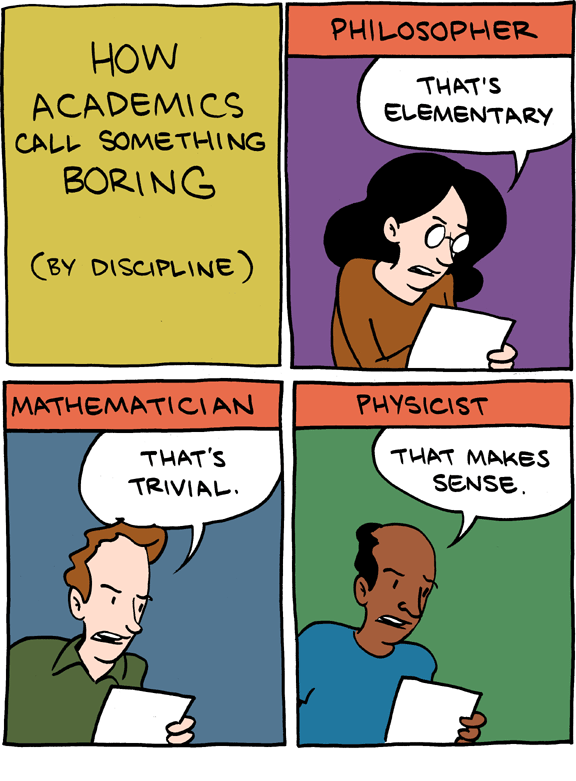
Let's round it all out with this cartoon from SMBC:
[Richard Muller] basically appears to have suffered from nothing more than characteristic physicist arrogance, the belief that people in lesser sciences just don’t know what they’re doing. (Economists experience this all the time, but we make up for it by being equally condescending to sociologists.)
That's from Paul Krugman's comment on "one prominent skeptic who actually believed that the data was being manipulated has reported in detail on his efforts to produce clean climate data. And guess what: his data overwhelmingly confirm what climate scientists have been saying."
"Fuck yeah, rapidly solidified alloys shown by means of electron diffraction to possess icosahedral symmetry—a little phenomenon known as quasicrystallinity, bitches!" said one chemistry fan who helped overturn a parked car as a mob chanted the name of prizewinner Daniel Shechtman.
The BusinessStandard has published two responses to a recent allegation by N.R. Narayana Murthy of Infosys that IIT students are not as good as their seniors, and his identification of the cramschool culture as the main reason behind this deterioration in quality. The responses are from big hitters from the IIT system: Prof. Gautam Barua (Director, IIT-G) and Prof. S. Prasad (former Director, IIT-D). NRN gets results!
Here's Barua:
So how do we improve the “quality” of IIT graduates? Based on the points above, the obvious answers are to increase the numbers of those who are really interested in a career in engineering or science, and to reduce the cases of mental fatigue. As far as the latter is concerned, the IIT Council has been discussing this issue and it has been decided in principle to do away with the Joint Entrance Exam (JEE) and instead use school results and the results of an aptitude test to decide admission. The wide variety in school board exams is sought to be handled by using the percentile rank of a student as the absolute marks of the school result. This will mean that the marks a student obtains will depend on her rank in her Board and on the size of the Board in which she is appearing.
And here's Prasad:
It is nobody’s case that the admission processes of the IIT system are perfect. Having reduced the question paper to a multiple-choice, objective test, imperfections have crept in, which the coaching institutions have exploited. Therefore, it is impossible to guarantee that everyone who has cracked the Joint Entrance Examination is brilliant. There is no doubt that there is great scope for improving our admission processes and factoring in more information about the candidate than performance in a single test. Perhaps factoring in school results, as is being considered, will help. Perhaps we need to include a component of subjective testing, as used to be done in the past. There are many dimensions for bringing in such improvements.
In other news, the IITs announced their most serious attempt to address the issue of student quality: students now need to score 10% in each subject (and 35 % in the aggregate) in JEE-2012.
An editorial in DNA has declared the arrival or Bangalore 3.0! .
Right now, it covers only a 7 km stretch from M.G. Road downtown to Baiyappanahalli in East Bengaluru -- in a direction away from where we are, but one of the lines will come our way (it's still about a kilometer from our Institute). All in all, when the entire project is finished, a fairly large part of our great city will come under Namma Metro's benevolent coverage. [There's also at least one special line that will connect the city to the airport, some 35 km from downtown.]
Historic day for all of us at Bengaluru.
* * *
Churumuri has fabulous pictures of the MG Road station -- taken one day before the launch. Eye Candy!
In his editorial, Prof. P. Balaram summarizes the history of the discovery of quasicrystals and its aftermath, interleaving them with musings on two other high profile discoveries from the 1980s -- high Tc superconductivity and Fullerenes.
Towards the end, he gets to the Linus Pauling's intense -- and intensely misguided -- opposition to the idea of quasicrystals ("there are no quasicrystals, only quasi-scientists," he quipped), and concludes that the "duel over the nature of quasicrystals seems mild" when one actually considers some of the "past battles in science" that have been far more vicious. How vicious? He quotes from Jacob Bronowski's Ascent of Man:
Who would think that only in 1900, people were battling, one might say to the death, over the issue whether atoms are real or not. The great philosopher Ernst Mach in Vienna said, No. The great chemist Wilhelm Ostwald said, No. And yet one man, at the critical turn of the century, stood up for the reality of atoms on fundamental grounds of theory. He was Ludwig Boltzmann…. Did Boltzmann just argue? No. He lived and died that passion. In 1906, at the age of sixty two, feeling isolated and defeated, at the very moment when atomic doctrine was going to win, he thought all was lost, and he committed suicide.
Balaram has produced an engrossing essay, but he gets one thing wrong -- that quasicrystals, somehow, imply a "demise of order." As my colleague Prof. S. Ranganathan said in an e-mail conversation (excerpted here with his permission):
... To echo Mark Twain, Perfect Order might as well say "The report of my death was an exaggeration," ... Quasicrystals are as highly ordered as crystals. What they lack is strict translational periodicity, but they sport "forbidden "rotational symmetries -- they are quasiperiodic. ... The divorce between order and periodicity is the beauty of Shechtman's discovery. [bold emphasis added]
* * *
Update: Here's another another great quote I received from Prof. Ranganathan; I'm reproducing his e-mail in its entirety:
From Mark Twain to G K Chesterton via Martin Gardner:
A sort of secret treason in the Universe
G. K. Chesterton once suggested that an extraterrestrial being, observing how many features of a human body are duplicated on the left and the right, would reasonably deduce that we have a heart on each side. The world, he said, "looks just a little more mathematical and regular than it is; its exactitude is obvious, but its inexactitude is hidden; its wildness lies in wait." Everywhere there is a "silent swerving from accuracy by an inch that is the uncanny element in everything . . . a sort of secret treason in the universe."
The passage is a nice description of Penrose's planar worlds.
The tablet runs Android 2.2, and has a 7-inch resistive display, 256 MB of RAM and 2GB in a flash drive. And it has 2 USB ports. This neat little package -- made in India -- will be available at retail stores for about $60. This NDTV story has lots of positive things to say about the device. And you can see it in actioin in this video, which also features an August 2010 interview with Mr. Sibal [Here's a preview of the device from that episode]
Here's another NDTV interview of Mr. Sibal [or watch it there]:
Prof. Shechtman's Prize is for his pioneering work on quasicrystals (in aluminum-manganese alloys) which showed a five-fold rotation symmetry -- the kind of symmetry that was (then) forbidden in 'normal' crystals. I can go on and on, but there's nothing better than a video in which Prof. Shechtman himself explains his work:
One of the interesting bits in the story is the strong, intense opposition to the idea of quasicrystals from Linus Pauling -- a Chemistry Nobel Laureate, and a mega-giant in chemistry. Prof. Shechtman needed to overcome the skepticism (and sometimes, open hostility) of many, many scientific colleagues who just couldn't believe his results and their radical implications. In one of his talks here at IISc, I remember him talking about scientists who said, basically, "Here's what Pauling says, and here's what Shechtman says. Now, who would you believe?" And many of those who said this were chemists who were sure that Pauling could never go wrong.
I think it is absolutely wonderful that it is the Chemistry Prize that has gone to Prof. Shechtman.
Congratulations to Prof. Shechtman!
* * *
Update: Way back in 2005, I wrote a post about three mini-revolutions that shook materials science / condensed matter physics / solid state chemistry in the 1980s. The discovery of quasicrystals was one of them, with the other two being high Tc superconductivity and C-60 (Buckminsterfullerenes, fullerenes or buckyballs). While C60 won the 1997 Chemistry Prize, the work that laid the foundation for the discovery of high Tc superconductivity won the 1987 Physics Prize.
The discovery of quasicrystals had to wait a while for the Prize, but the timing is exquisite -- it won it in the International Year of Chemistry!
Update 2: The Information for the Public issued by the Nobel Foundation does a good job of summarizing some of the history behind the discovery of quasicrystals, and ends with "an important lesson for scientists." Some excerpts:
When Shechtman told scientists about his discovery, he was faced with complete opposition, and some colleagues even resorted to ridicule. Many claimed that what he had observed was in fact a twin crystal. The head of the laboratory gave him a textbook of crystallography and suggested he should read it. Shechtman, of course, already knew what it said but trusted his experiments more than the textbook. All the commotion finally led his boss to ask him to leave the research group, as Schechtman himself recalled later. The situation had become too embarrassing. [...]
[Immediately after Shechtman published his work] the discovery now reached a wider audience, and Daniel Shechtman became the target of even more criticism. At the same time, however, crystallographers around the world had a moment of déjà vu. Many of them had obtained similar diffraction patterns during analyses of other materials, but had interpreted those patterns as evidence of twin crystals. Now they started digging around in their drawers for old laboratory notes, and pretty soon other crystals began to appear with seemingly impossible patterns, such as
eight- and twelvefold symmetries. [...]
An important lesson for science
Daniel Shechtman’s story is by no means unique. Over and over again in the history of science, researchers have been forced to do battle with established “truths”, which in hindsight have proven to be no more than mere assumptions. One of the fiercest critics of Daniel Shechtman and his quasicrystals was Linus Pauling, himself a Nobel Laureate on two occasions. This clearly shows that even our greatest scientists are not immune to getting stuck in convention. Keeping an open mind and daring to question established knowledge may in fact be a scientist’s most important character traits.
The follow-up video is pretty good too. Love it where Prof. Rod Cross says, "We study physics because a lot of unexpected things happen. It's those unexpected things that make physics interesting"
The alleged controversy about what the Nobel Foundation would do has been put to rest. But this is truly moving:
... Dr. Ralph Steinman ... actually used his discoveries in the laboratory to try to save his own life. His career-long quest had been to develop a vaccine against cancer for humans, having shown 20 years ago that such a treatment could be effective in mice.
Four and a half years ago, after he was found to be jaundiced from a spreading pancreatic cancer, he began tailoring an experimental vaccine against his own tumor. The idea was to use the principles learned in the experiments on mice and in the laboratory to produce immune cells derived from his dendritic cells, a class of cells that he discovered in 1973.
After a piece of Dr. Steinman’s cancer was removed, a colleague, Dr. Michel Nussenzweig, grew it in the laboratory to produce enough material to send to at least 20 researchers at Rockefeller University and at least five other laboratories around the world. Dr. Steinman organized the work among the researchers who developed the experimental vaccine.
Dr. Steinman received standard chemotherapy for his cancer as well as the experimental vaccine, which other doctors at Rockefeller University injected under his skin, Dr. Nussenzweig said Monday in a telephone interview. ...
“Ralph believed strongly that it would work,” Dr. Nussenzweig said. “Obviously, it did not work or he would be here now, but possibly it prolonged his life.” The research, he added, will continue.
Stephen S. Hall has a grim report in Nature: Scientists on Trial: At Fault? "In 2009, an earthquake devastated the Italian city of L'Aquila and killed more than 300 people. Now, scientists are on trial for manslaughter."
... do the writing tutors of the world really think we should not report that a politician has been shot until we can specify the gunman? Do they honestly think it’s wrong to say that the lights are left on all night in an office building without supplying a list of the individuals who controlled the switches? We really have to get over this superstitious horror about passives. It’s gone beyond a joke.