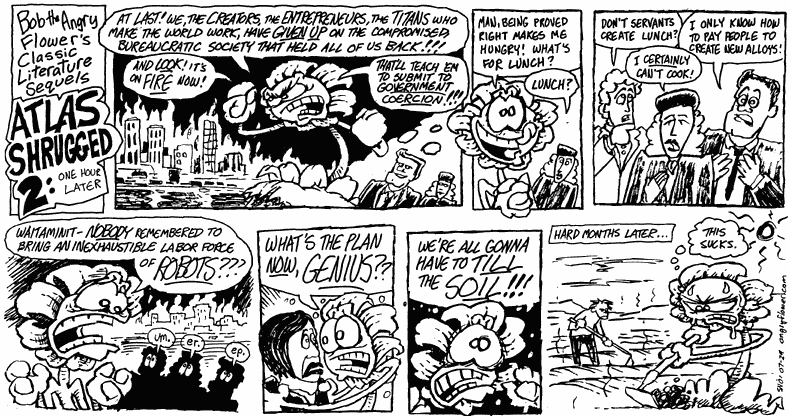
Bob the Angry Flower's Classic Literature Sequels: Atlas Shrugged 2: One Hour Later.
A New Yorker cartoon featured in Paul Krugman's blog.
Saturday, April 17, 2010
Two cartoons about libertarians


Friday, April 16, 2010
Rant of the Day
Fuve Things The Media Loves Pretending Are News.
* * *
[Yeah, I know it's nearly two months old; but I just heard about it today. Via Samia.]
Collaborative Math
Filed under: Blogging, Popular Science, Science
Julie Rehmeyer of Science News has what I think is one of the best versions of the story of the Polymath Project -- mathematician Tim Gowers's successful experiment to solve a non-trivial mathematical problem using online collaboration through his blog (and, later, a wiki).
[In January 2009,] University of Cambridge mathematician Tim Gowers decided to run a little experiment. Was it possible, he wondered, for a large number of mathematicians to collaborate openly on the Internet, pooling their ideas around a single problem? If it were possible, would it be easier, more efficient, more fun? Could the mathematicians together solve a problem they might not be able to solve individually?
So he posed a problem on his blog, one that was important and challenging and that lots of people had already worked on, including himself. [...]
Thursday, April 15, 2010
Must-read article of the day: The Single Mother's Manifesto
Filed under: Politics, Sociology, The Good Society
Yes, that Rowling.
It's about the ugly politics of the Tories, narrated using a bunch of inter-related things: raising a family as a single mother, watching single-parent families "castigated ... as 'one of the biggest social problems of our day,' and the importance of -- and gratitude for -- the safety net provided by the Welfare State that the Tories treat with great hostility.
It's great stuff -- mixing the personal and the political in a way that packs awesome power. Excerpts won't do justice to it, so just go read the whole thing.
Pushback time
Filed under: Entrance Exams, HigherEd-India, IITs
It was just yesterday when Charu Sudan Kasturi reported in The Telegraph on the very interesting contents of a report from a committee of IIT directors suggesting that JEE be replaced by a combination of Board exams and a SAT-like aptitude test.
Some of the early reaction [here, here and here] has focused on coaching centers: since the proposed move strikes at the very soul of their business, we may expect them oppose it with all their might.
Coaching centers may yet get into the act, but the credit for being the first off the block should go to the one constituency that is bound tightly to the JEE -- the IIT alumni.
Here's their petition: An appeal not to abolish JEE. [Hat tip: Apoorva Mathad's comment on this buzz]
I wouldn't take the petition's contents as representing the views of all the IITians; with that caveat out of the way, I've got to admit that it's an amazing document. With its condescending tone, marketing jargon, sad grammar, and poor punctuation, it's still a virtual gold mine -- offering us nuggets of insight into how some IITians view themselves, their achievements, and their relationship with the rest of India and the world.
Some excerpts [with my 'commentary' restricted to adding bold emphasis]:
[In JEE, there] was no emphasis on overall performance at high school and none on student's educational background, promoting a level playing field for students from nooks and corners of India.
The success of IIT alumni who have done the Nation proud belongs to the Indian Government, the IITs themselves and also the Indian Tax Payers, whose money was invested unconditionally by GoI in IITs for five decades.
Whilst all of the above share credit for the success of the IITs, basic marketing principles would say that a Global Brand is created more by its graduates and the benefits that those alumni bring to India and the world at large, than any other single entity; thus, IIT Alumni is a critically important group to consider.
The key ingredient to the IIT system is the JEE ( Joint Entrance Examination ), that has helped pick truly gifted students for 50 years for a B.Tech Degree. Quality materials are needed to develop a quality product, and JEE does just that, selecting from about 400,000 aspirants annually, the cream of the nation to study at IITs.
Any system that has consistently delivered high on career development can be prone to abuse. There have been allegations of some misuse of the JEE too. Private coaching classes have mushroomed around the country to circumvent JEE methodologies used to identify excellence. This needs to be fixed.
However abolishing JEE would be a case of "throwing the baby out with the bath water". We are sure you will see our appeal is fair, in the best interest of the nation and children of the future.
Okay, I can go on and on [and the entire petition cries out to be fisked], but I think I should stop with this:
JEE is very different from 10+2 board exams in that JEE tests a students raw intelligence, which is an individual's ability to grasp abstract concepts, recognize patterns plus apply prior knowledge while 10+2 school board exams test knowledge acquired at school. [...]
Wednesday, April 14, 2010
IITs Radical Idea: Board Exam Marks to be Given 70 % Weight
Filed under: Entrance Exams, HigherEd-India, IITs
It takes a lot of guts to reject the old (but increasingly dysfunctional) way of life mode of admissions, and I commend the IIT Directors for this radical idea [thanks to Pradeepkumar for the e-mail alert]. We don't know the final shape of this idea (just raw marks will not work, so we'll need some sort of scaling or normalizing -- we just don't have those implementation-level details), but for the moment, let me just say that I like this proposal. I really, really like it.
The IITs and all other engineering schools may soon pick students based more on board examination marks than on entrance test performances, under testing reforms recommended by a panel of IIT directors.
The panel, appointed by human resource development minister Kapil Sibal, has recommended replacing the four-decade-old IIT-Joint Entrance Examination (JEE) and myriad other engineering entrance examinations with a common test modelled on the US-based scholastic aptitude test (SAT).
The panel has suggested that the IITs accord a 70 per cent weightage to board examination scores in picking students [...]
Monday, April 12, 2010
Marriage vs. The PhD
A great cartoon at -- where else? -- the PhD Comics.
Thanks to Pratik Ray for his nudge.
Monday Mornings With Math
Filed under: Popular Science
This week's episode of Steven Strogatz's series -- Math: From Basic To Baffling -- is on calculus: Change We Can Believe In:
Calculus is the mathematics of change. It describes everything from the spread of epidemics to the zigs and zags of a well-thrown curveball. The subject is gargantuan — and so are its textbooks. Many exceed 1,000 pages and work nicely as doorstops.
But within that bulk you’ll find two ideas shining through. All the rest, as Rabbi Hillel said of the Golden Rule, is just commentary. Those two ideas are the “derivative” and the “integral.” Each dominates its own half of the subject, named in their honor as differential and integral calculus.
Roughly speaking, the derivative tells you how fast something is changing; the integral tells you how much it’s accumulating. They were born in separate times and places: integrals, in Greece around 250 B.C.; derivatives, in England and Germany in the mid-1600s. Yet in a twist straight out of a Dickens novel, they’ve turned out to be blood relatives — though it took almost two millennia to see the family resemblance.
Prof. Venki Ramakrishnan's Autobiographical Essay
From Chidambaram to Cambridge: A Life in Science.
The essay will eventually find a home on the Nobel Prize website. The current version, hosted by The Hindu, lacks the pictures that Prof. Ramakrishnan included in the essay.
There's a lot in the essay that will be of interest to Indians; there are sections on his school and college education, and on his somewhat more regular visits to India since 2002. And also on how he has been treated like a rock star during his post-Nobel visit to India. "I have come to realize," he concludes, "that I have inadvertently become a source of inspiration and hope for people in India simply by the fact that I grew up there and went to my local university, but could nevertheless go on to do well internationally."
I had already listened to Venki's talk at IISc; it is still nice to see the details on people, places and cultures that had influenced the man.
Here's a short excerpt where Prof. Ramakrishnan's thoughts on the politics of scientific recognition:
The Politics of Scientific Recognition
People go into science out of curiosity, not to win an award. But scientists are human, and have ambitions. Even the best scientists are often insecure and feel the need for recognition. Our ribosome work led to lots of invitations to give seminars and speak at conferences. It resulted in my election to the Royal Society and the U.S. National Academy of Sciences and also led me to receive a prestigious European prize, the 2007 Louis-Jeantet prize for medicine. Thus in both my scientific efforts and the recognition for it, I had succeeded beyond my wildest dreams.
Although few scientists are foolish enough to enter a field to win a Nobel Prize, ever since the 30S subunit had been solved, people would regularly bring up “the Prize” in conversations whenever I went to conferences or give seminars. It was clear to me that the ribosome was at least as important as other structures that had been awarded the Nobel Prize. But there were many more than three people who had contributed to the ribosome, even if one only counted principal investigators, which itself is a fictional view of the way modern science is done.
While we were solving the structure of the 30S subunit, I had mostly refused to be distracted by going to meetings to speak about our work. So it was something of a shock when only a couple of months after the atomic structures of the subunits came out, a prize in the USA was awarded to just one aspect of the ribosome, peptidyl transferase. It seemed to me that instead of waiting for the impact of the ribosome work to become clear and then thinking hard about what had really made a difference to the field, the committee had hurriedly decided on which three people they wanted to honor and then written a citation around them that would exclude the others. Richard Henderson, my director, suggested that I should accept more invitations to meetings and talks to get our story known if only to get proper recognition for our work, regardless of prizes.
Deep down, I felt that the scientific event that transformed the field more than anything else was the determination of the atomic structures of the ribosomal subunits and the functional studies that followed as a result, to which we had made a major contribution. However, international prizes for work on ribosomes always seemed to go to other people. So over the years, I had gradually come to accept that I would probably not get a major international prize for the ribosome, least of all the Nobel Prize. Once I had accepted that, I felt liberated and happier, but I have to confess that I felt some trepidation each October. Every time I learned the Nobel Prize was for something other than the ribosome, I would be relieved because it was a postponement of what I felt would be the inevitable disappointment. As the years went by, it seemed to me and many other scientists that there would never be a Nobel Prize for the ribosome because the problem of choosing three people out of all the contributors appeared insurmountable.
Sunday, April 11, 2010
Philip Pullman: No one has the right to spend their life without being offended
Filed under: Philosophy, Religion
Just watch the author of The Good Man Jesus and the Scoundrel Christ:
If the embed doesn't work, watch it at YouTube.
Surviving Your Stupid, Stupid Decision ...
Filed under: Books, HigherEd-Advice
... to Go to Graduate School.
Adam Ruben's book with that title promises to be a lot of fun, if we go by Scott Jaschik's preview:
... [Ruben] covers everything from selecting professors to work with to figuring out when you need to finish up already (the latter in a chapter appropriate for the Passover season, "Let My Pupil Go.")
There are more professorial types to avoid, in Ruben's world, than to cling to. You want to watch out for the "jet setter" (she's "giving the keynote address at a different conference every week" and so doesn't believe in such duties as "hand-holding" or "clarifying" or "anything"); the "deaf optimist" ("Bad news about your research? Say no more, No, really -- say no more, because she won't hear it."); or "the founder" (the longest serving faculty member in the department... "think Strom Thurmond meets George Burns, but without the racism or the entertainment... well, maybe a little racism.")
Other sections cover important ways to answer questions, such as the passive-aggressive answer that "implies the question was poorly worded." And there are graduate student recipes, such as "Roasted Undergraduate on a Spit" (to fantasize about), "Macaroni and Tears" (to eat) and "Bribery Brownies" (to serve your committee members). Ruben also focuses on the importance of getting out of grad school by actually finishing a dissertation, and he discusses the difficulties of satisfying committee members -- who want their work cited, want certain ideas explored and so forth, without regard to the original concept. (Ruben reads that section in a podcast that can be found here.)
Must-read Article of the Day: Krugman on the Economics of Climate Change
Filed under: Climate Change, Economics, Physics
Paul Krugman has an excellent primer on what environmental economics has to say about climate change and strategies to mitigate it: Building a Green Economy in NYTimes Magazine:
In what follows, I will offer a brief survey of the economics of climate change or, more precisely, the economics of lessening climate change. I’ll try to lay out the areas of broad agreement as well as those that remain in major dispute.
Here's an excerpt from the section on Pigouvian tax (and its cousin -- the Cap and Trade) to soften the impact of 'negative externalities' -- "costs that economic actors impose on others without paying a price for their actions":
... What Pigou enunciated was a principle: economic activities that impose unrequited costs on other people should not always be banned, but they should be discouraged. And the right way to curb an activity, in most cases, is to put a price on it. So Pigou proposed that people who generate negative externalities should have to pay a fee reflecting the costs they impose on others — what has come to be known as a Pigovian tax. The simplest version of a Pigovian tax is an effluent fee: anyone who dumps pollutants into a river, or emits them into the air, must pay a sum proportional to the amount dumped.
Pigou’s analysis lay mostly fallow for almost half a century, as economists spent their time grappling with issues that seemed more pressing, like the Great Depression. But with the rise of environmental regulation, economists dusted off Pigou and began pressing for a “market-based” approach that gives the private sector an incentive, via prices, to limit pollution, as opposed to a “command and control” fix that issues specific instructions in the form of regulations.
The initial reaction by many environmental activists to this idea was hostile, largely on moral grounds. Pollution, they felt, should be treated like a crime rather than something you have the right to do as long as you pay enough money. Moral concerns aside, there was also considerable skepticism about whether market incentives would actually be successful in reducing pollution. Even today, Pigovian taxes as originally envisaged are relatively rare. The most successful example I’ve been able to find is a Dutch tax on discharges of water containing organic materials.
What has caught on instead is a variant that most economists consider more or less equivalent: a system of tradable emissions permits, a k a cap and trade. In this model, a limited number of licenses to emit a specified pollutant, like sulfur dioxide, are issued. A business that wants to create more pollution than it is licensed for can go out and buy additional licenses from other parties; a firm that has more licenses than it intends to use can sell its surplus. This gives everyone an incentive to reduce pollution, because buyers would not have to acquire as many licenses if they can cut back on their emissions, and sellers can unload more licenses if they do the same. In fact, economically, a cap-and-trade system produces the same incentives to reduce pollution as a Pigovian tax, with the price of licenses effectively serving as a tax on pollution.
Tuesday, April 06, 2010
Prisoner's Dilemma and Monty Hall played by rats and pigeons
Interesting stuff:
Brian Mossop at The Scientist Blog: Rats Playing Prisoners' Dilemma (especially the iterated version).
Ed Yong at Not Exactly Rocket Science: Pigeons Outperform Humans at Monty Hall Dilemma.
Bonus link (from Boing Boing's Cory Doctorow: Ant Slaves' Murderous Rebellions.
Monday, April 05, 2010
Monday Mornings are for Math
Filed under: Popular Science
I missed linking to last week's installment of Steven Strogatz's series -- Math: From Basic to Baffling. Here, then, are two links:
Power Tools: In math, the function of functions is to transform.
A mathematician needs functions for the same reason that a builder needs hammers and drills. Tools transform things. So do functions. In fact, mathematicians often refer to them as “transformations” because of this. But instead of wood or steel, functions pound away on numbers and shapes and, sometimes, even on other functions.
Take It To The Limit -- Archimedes recognized the power of the infinite, and in the process laid the groundwork for calculus.
The key to thinking mathematically about curved shapes is to pretend they’re made up of lots of little straight pieces. That’s not really true, but it works … as long as you take it to the limit and imagine infinitely many pieces, each infinitesimally small. That’s the crucial idea behind all of calculus.
Following the excellent tradition he has established in this series, Strogatz then goes on to provide an intuitive proof for the well known relation between a circle's area (A) and its radius (r): A = π r2.
Kalid Azad's Better Explained is the best resource for simple explanations of math concepts (and business concepts, programming concepts, ... ;-). So I checked to see if Azad has covered the Problem of Pi, and sure enough, he has. So, here are a couple of links:
Prehistoric Calculus: Discovering Pi describes the logic behind Archimedes's method of calculating π .
A Gentle Introduction To Learning Calculus has a different -- but equally intuitive -- proof for the relationship between a circle's area and its radius: A = π r2
Subscribe to:
Posts (Atom)